Monday, July 10, 2006

Lughnasadh Sabbat


The Summer progresses apace and our next Sabbat will be Lughnasadh on 2nd August, this is the festival of First Fruits and the start of the grain harvest. The Spirit of the Corn will be captured in Corn Dollies where the seeds of regeneration will be kept for the following year to manifest in the Harvest once again. This year we will honour Lugh, Balor and Tailiu and so it will be a good time for our Witches to brush up on their Gaelic ! Deideil mar thriallas a 'ghrian..... Gu fior chare na h-airde deas.

July Full Moon

The Full Moon of July we know as the Wort Moon, 'wyrt' being the Anglo-Saxon word for herb, and we shall continue to gather our magical herbs and flowers. When they are harvested and hung up to dry we give thanks to the Spirits who dwell in our Herb Garden on the East side of our Circle, and we'll leave them an offering. As we place this offering in our moonlit garden the Spirits whisper secrets of herb lore to us. Soon we will be gathering grain to be used in our Lughnasadh Ritual with the Sabbat group.

Saturday, May 27, 2006

Summer Solstice


The next Sabbat will be on Thursday 22nd June, Mid Summers Day. The longest day of the year when we celebrate the vital energy of Fire and salute the Sun at the height of its powers. Now the turning Wheel of the Year briefly stands still and we begin a new phase, the descent into darkness. The Sun's power begins to wane as it starts the long journey into Winter. At this time the Oak King must depart and give way to his twin the Holly King, Lord of the Shadows, who will hold sway over the Earth til Midwinter.
At Stonehenge the sun is seen to rise at the end of the Avenue in line with the Heel stone and cast a shadow to the Altar.
Midsummer is traditionally a 'Spirit Night' when one may be visited by ancestors, spirits or the Fey. Due to our location amongst the Tumuli of Martlesham we are ideally situated to commune with previous dwellers of this land.Blessed be.

Thursday, May 25, 2006

June Esbat

The full-moon of June 11th we refer to as the Mead Moon, traditionally the time when the Meads or meadows were mown for hay. This is the ideal time to gather herbs as the concentration of active constituents in a plant varies during its life cycle; it is best to collect leafy herbs just at the stage of first flowering before the plant begins to put all its energies into the developing seeds.
During May the countryside has been filled with spectacular blossoms and the bees have been gathering the nectar to fill their hives with honey. Honey is then used by witches to brew Mead, the favoured drink of the ancients. Mead is considered to have magical and restorative properties and much is consumed by the Coven at this time.
This is also the time when, as we sip this drink of the Gods, we ourselves will be ready to receive the inspiration of the higher realms.
Over the week-end of the full moon the witches of Carlford Coven will be involved in the Ipswich Riverside Folk and Maritime Festival www.irfmf.org.uk
held at the Steamboat Tavern, Ipswich.

Tuesday, May 09, 2006

Full Moon Esbat

May Full Moon
In May we will celebrate the Dyad Moon with the Sun moving towards Gemini and the Moon in ardent Sagittarius. Dyad is the latin for 'pair'and this is the time of the annual symbolic Greenwood Marriage of the Goddess in her aspect of the Fertile Earth and the God in his aspect of the young Oak King, when opposites meet in perfect balance to become as one in harmony.
We will meet at The Triple Goddess Crossroads in love and merriment to unite with all nature and enact the Great Rite under the Full Moon serenaded by Nightingales.
We will collect Spring Water from our favourite source at this magical time and give thanks for recent successful outcomes to our Workings and honour the Fey as this is traditionally the time for the Elf Queen to ride out with her Court at mid-night..............
Let there be beauty and strength, power and compassion, honour and humility, mirth and reverence within you.......

Thursday, April 13, 2006

Beltaine

The next Carlford Coven Esbat is Thursday 13th April. We call this moon the Hare Moon and as she waxes full we will concentrate on and observe the rabbits and hares leaping and playing, carefree in their mating and joyful in their games. This sacred animal was associated in legend with springtime and fertility and they will make us feel within our hearts the carefree nature of these wild creatures.

The next Sabat will be Beltaine Sunday 30th April (May Eve) when we will rekindling the Belfire in our cauldron using nine witches to carry the nine sacred woods helped by our Woodland Sprite. We will be celebrating the Greenwood Marriage of the Goddess as Lady of the Greening Earth, with the God as Lord of the Greenwood, their union brings fertility to all the Earth.

Wednesday, March 22, 2006

Ostara

It's a celebration that we have now revolved through all the seasons at this site. Last year's ceremony to celebrate Ostara (which we then called Oestre, only because either name can be used) remains on the site at Oestre where you will find more pictures of this year's successful rite.

This year our High Priestess delighted us all by painting eggs which were presented during the rite. Our Maid chose Cernunnos and Blodeuwedd to celebrate this coming together of the Mother Goddess and her brother-lover-son.

The spring equinox is an appropriate time to consider the coming Spring when all life will start to reproduce.

The success of any Coven rests upon the energy and commitment of the High Priest, High Priestess and Maid. We are indeed blessed.

Tuesday, February 28, 2006

Raven Moon & Oestre

This is a wonderful time of the year (for those of us who live in the northern half of this beautiful world). Signs of new life are beginning to appear everywhere. We celebrate two rituals this month:

On 14 March our March Moon will consider the Raven, that proud member of the Corvus family, that has long been associated with mankind.

The 20 March brings Oestre, the Spring equinox, signalling equality and balance and the promise of joy and vitality to come.

Take some time to consider the thoughts of J R Gower, the Gwidion McPagan, who writes;

Taking the longest view, we are beginning to reach for the stars, yet we still act like spoilt, immature infants. Standing under the full Moon, lit by the flickering firelight and invoking the Deities, the human mind that knows itself as part of the whole can transcend mortal perception, as it has since the most ancient cultures, and fleetingly touch minds with the infinite.

That is why we share a language of Goddesses and Gods, of myths and vision, of the celebration of love and life, and hold them sacred. Ours is a tradition of recognising supernality

In reality, both that of the 'experiential reality' of the human mind, and of the 'objective reality' whereby we have now begun to understand the processes of
existence itself. The deepest principles of natural spirituality are also those upon which our future depends.

Nature will provide any cultural species (and we can no longer support the absurd vanity that we are the only, or in any way an exclusive one) with the same lesson. If you don't become sufficiently mature to care for your environment and each other, you will ruin that which provided everything you needed to outlive your solar system and you will end your own evolution. That is, quite simply, the truth. It is also why natural spirituality is reasserting its place in a scientifically aware world, and why the age of 'religions' is ending. Reality cannot be defined by a 'dogmatic set of beliefs', no matter how many choose to 'believe in' it, and such 'beliefs' create conflict.

If we do take the path of maturity and destiny, we shall eventually meet others. Considering whether they will have had to learn the lessons we know are crucial to our own destiny, natural spirituality is inclusive, religion ism is not.

Such a destiny has been considered by cosmologists and anthropologists. It is estimated some six million years will see us colonising the far reaches of our galaxy, but only if we can depend on Earth's environment for many millennia to come. During that future, there will come a time when human genes at one end of the 'sphere of expansion' will never meet with those at the opposite end, and our evolution will begin to branch. The children of Earth will have children of their own.

Does existence have a purpose? Try approaching it from another perspective: If our Universe had never given rise to life, would it have purpose? Without life, whence supernality?

For us, spirituality is our relationship to the infinite whole, and supernality is ; the experiential reality of that whole. Our great spectrum of Pagan traditions is at heart life celebrating existence itself.

Thus, blessed be.

Saturday, February 04, 2006

Looking Towards the Light

As we pass into the light following Imbloc it's a good time for reflection. Gwydion McPagan, also known as JR Gower wrote these Words from the Path;

'The growth of interest in our Pagan traditions at this time is meteoric. Though many learn the 'content' of our traditions such as the annual festivals, various 'life ceremonies' and the characteristics, myths and associations of a retinue of Goddesses & Gods (deities) and their interrelated symbolism, very few start with an understanding of the absolute 'basic' concepts which underlie this symbolism.

Due to the historical enforcement of 'sets of beliefs' by the 'dogmatic religions', for instance a 'creator God' essentially independent of existence itself, heaven, hell, the idea that evil forces exist independently of life, in fact all the 'beliefs' of monotheism, have become the generally unquestioned 'spiritual' concepts of our society.

Once you lay aside all these 'religious' preconceptions and look for supernality rather than 'God', you are entering the realm of pure spirituality rather than religion. It comes as a surprise to many, even many newcomers who already consider themselves Pagan, just how different and more appropriate to the modem world the ancient principles of Paganism are when interpreted in the light of contemporary human knowledge about the Universe we inhabit.

Pantheism is the recognition of supernality symbolised in the form of archetypal deities, each characteristic of supernal 'components' of our shared 'experiential reality'.

With this perspective, consider the question 'Does existence have any purpose, and if so, what relevance does It have for me?

In the beginning, when our Universe began as an infinitesimally tiny seed of pure energy, everything that is now your body and your mind, even the tiny energies that comprise your thoughts, was intimately and utterly combined with everything that now exists.

All that is now you has always been part of the whole, part of the unfolding of time and space, part of the first stars whose light first lit the heavens and gave rise to the elements we now know made life possible.

You are made from the dust of the Earth, the dust of ancient stars. When part of that dust began to replicate itself, an inevitable process that our Universe has perfected by its nature, it was a path of evolution of some four billion years so far, giving rise to you. We are the children of this Earth, and since our emergence as a 'cultural species', all but a tiny part of our history was in the great playground and school of the palaeolithic world.

In the light of our Pagan traditions, we can see the current time as one of both enlightenment, as science seems to reinforce our 'pantheist' principles, and yet one of barbarism, conflict, oppression and suffering that flies in the face of every spiritual aspiration and principle.'

Take time to consider these profound statements.

Saturday, January 14, 2006

Imbolc

As we move towards February Brigid the Celtic goddess has her festival, known as Imbolc (Irish: I mbolg, in the belly) Oimelc (the lactation of ewes). That’s the substance of Imbolc, the end of winter, as the flow of milk heralds the return of the life-giving forces of spring.

In Britain February is the harshest month of the year. In Scotland this period was called Faoilleach, the Wolf-month or ’marbh mhiòs, the Dead-month. Signs of the end of winter begin to appear. Lambs are born and the grass begins to grow, the first spring bulbs flower.

The holiday is a festival of light, reflecting the lengthening of the day and the hope of spring. In many laces all the lamps of the house are lit for a few minutes on Imbolc. Traces of the festival of the growing light can even be traced to modern America in the Groundhog Day custom on February 2. If the groundhog sees his shadow on this morning, it means there will be six more weeks of winter. An old couplet goes: If Candlemas Day is bright and clear, there'll be two winters in the year.

The old woman of winter, the Cailleach, is about to be reborn as Bride, the young maiden of Spring. Young girl she may appear but she has the power of a deity. Brigid is the ‘Exalted One’ known throughout Europe with similar names, possibly coming from Vedic Sanskrit, where brihati means divine.

In Ireland she is the daughter of the Daghda of the Tuatha de Danaan. A woman of wisdom, the source of oracles. She has two sisters: Brigid the Physician and Brigid the Smith, all aspects of the one goddess of poetry, healing, and metal working. A goddess of dying, weaving, brewing she is the provider of plenty bringing natural bounties for the good of people.

She has two oxen, Fea and Feimhean, whose memories are still locked to the landscape of County Carlow and Tipperary. She is the guardian of Torc Triath, king of the wild boar, who named Treithirne, in West Tipperary. These three totem animals raise a warning cry if Ireland is in danger.

Bride put her finger in the river
On the Feast Day of Bride
And away went the hatching mother of the cold.
— Carmina Gadelica

From Brighid's feastday onwards the day gets longer and the night shorter, as the effects of the winter solstice lessen. The mystical truth was that Brigid brought back the light. On the eve of Là Fhéill Bhrìghde (St.Brigid’s Day), the Old Woman of Winter, the Cailleach, journeys to the magical isle in whose woods lies the miraculous Well of Youth. At the first glimmer of dawn, she drinks the water that bubbles in a crevice of a rock, and is transformed into Bride, the fair maid whose white wand turns the bare earth green again.

There are other versions of this story, and today we must adapt these to make our own celebrations. Like so many pagan festivals and traditions the Christians took up these legends, and created Candlemass and Saint Brigid.

Monday, January 09, 2006

Esbats and Sabats

The next Esbat at Carlford Coven will be on Saturday 14th January 2006, by invitation only. As this is the Moon of deepest winter we call it the Wolf Moon, recalling a time when our ancestors gathered closer round the hearth fire for protection as well as warmth, and could hear the howling of hungry wolves who had come closer to the habitations of man, perhaps hoping to find food to survive.

As the light of the newborn year slowly increases it is a good time to look back and learn from our experiences, bid the past farewell and let it go, in order to receive the Solar Year that has just begun.

At this Esbat we will be consecrating Wands, Brides Crosses, Candles which are to be used at the Imbolc Sabbat, and other tools.

We will be empowering Springwater from our favourite source which is about three miles away, which we will collect on the waxing of the moon.

The Next Sabbat will be on Thursday 2nd February 2006. The Celtic Cross Quarter Festival of Imbolc. We will be celebrating the first signs of the return of Spring with Brighid the Triple Goddess as the three daughters of Dagda; the Three Blessed Ladies: Poetess, Smith and Physician. We will ensure that the old year is swept away and the new welcomed in with Fire, Springwater and Milk. Our young Bride from last year will be our guest once again.

Friday, December 23, 2005

Wands


In Wicca and Ceremonial Magic, practitioners use wands for the channeling of energy. Though traditionally made of wood, they may also consist of metal or crystal.
Practitioners usually prune a branch from an Oak, Hazel, or other tree, or may even buy wood. It is often then carved, with decorations added. It is possible to purchase ready-made wands. However obtained the wand should be cleansed and made ready for ritual.
In the picture the wands shown are left to right:

High Priestess (HPS) Hazel Wand, HPS Laurel Snake Headed Wand,
In the centre is The Scourge

To the right the High Priest Willow Wands tipped with Carnelian from the seashore and embellished with Hemp.

Top: Willow wand tipped with East Anglian Fenland Bog-Oak.

Wednesday, December 21, 2005

Solstice


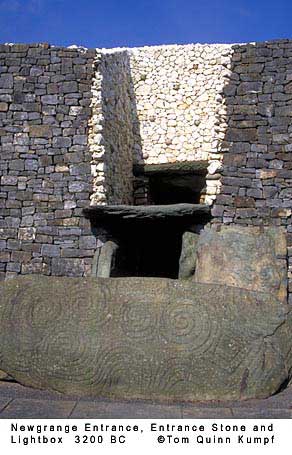
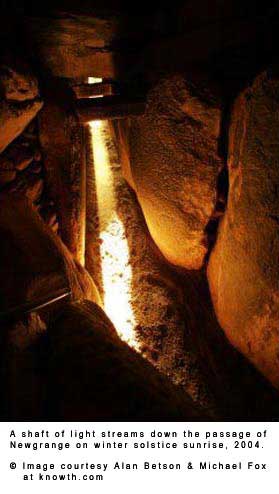
This morning at 9:02 in County Meath, Ireland the sun rose above the eastern horizon and entered the lightbox over the entrance of Newgrange Passage Tomb and gradually crawled down the main passage to a chamber.
Here fifteen lucky lottery winners stood watching the shaft of sunlight crawl across the floor and up a intricately carved vertical stone at the rear of the chamber. The entire event took about seventeen minutes and was created over 5200 years ago to mark the winter solstice. We have never been alone.
At 12.25 p.m. today the sun will appear to stand still for a few moments and then begin its annual move northward. The days will grow longer until June 21st when the sun will again appear to stand still and begin its move southward.
Today marks a new beginning of the cycle. Enjoy this day, the shortest daylight time of the year.
In our ceremony Holly will give way to Oak, whose strength will take us all onward towards Imbolg, when we shall mark the end of winter.

Thursday, December 15, 2005

Full Moon - this one is special

Make sure you spend some time gazing at the full moon tonight. It is very special.
This is the highest the moon has been in the sky for two decades and it will not return to this position for another 23 years.
This means it will seem to be very large in the night sky, and the forecast for our part of England is good. It should be clear and bright.
The moon has always held an especial fascination for mankind. Many people, me included, can feel its affects, particularly at full moon.
Yesterday it was revealed that evidence of a human species living at Pakefield, near Lowestoft, about 40 miles from our coven in Suffolk, over 200,000 years ago has been found. Those people will have gazed up at the same moon, in wonder, just as we will tonight.
This esbat is special and members of the coven will meet in philosophical and spiritual mood.
Blessings be.

Wednesday, December 14, 2005

Yule

The next Sabbat will be YULE (Winter Solstice) on 21st December.
We will be celebrating the return of the light as can be seen for this day by the lengthening daylight hours.
This year we will concentrate on the Wheel of the Year as represented by various trees, using the Holly and the Oak as the two Kings of the Year. Their bi-annual meeting at the Solstices symbolises the waxing and waning of the Sun's power and will be presided over at Yule by the Goddess in her guise of Queen of Mid Winter.
Coven members can look forward to magical happenings at this wonderfully festive time.

Tuesday, December 06, 2005

Cauldron


A cauldron or caldron (from Latin caldarium, hot bath) is a large metal-made pot (kettle) for cooking and/or boiling over an open fire, usually attached to a hanger with the shape of an arc.

In legend, a cauldron is purported to be where leprechauns keep their treasure.

In Wicca a cauldron is often placed at the centre of a sacred circle, and used to contain items that will be set alight during a ritual.

Traditionally, or in myth, a cauldron was also used by witches to prepare their potions, most notably the weird sisters in the play Macbeth.

As a cooking vessel it is now rarely used. The myth of the Holy Grail probably refers to a cauldron or similar vessel.

Monday, December 05, 2005

Athame


Athame or athamé is a ceremonial knife. In some traditions, the athame is a knife with a double edged blade and short (often black) handle; other traditions require that the blade be dull, curved, wavy, or a variety of other specifications.

The athame is usually used for ritual and magical purposes only, to direct energy; if something such as herbs or cord needs to be cut, another knife called a boline or white-handled knife is used.

Many traditions associate the athame with the masculine principle and with the element of air, though traditions associating it with fire are not uncommon.

As a masculine principle, it is often used in combination with the Graal, as feminine principle, and evokes clearly the act of procreation, as symbol of universal creativity. This moment is the central symbol of the Great Rite in Wicca rituals.

Other traditions forbid the ritual use of blades in general, or specifically of iron blades. This is most common amongst traditions that have a particular fondness of the Sidhe, to whom iron is supposedly harmful.

There are cleansing ritualsfor a newly acquired Athame, be it new, or acquired from another person.

There is no proven etymology for this word as it does not appear in any European Language. In the book Triumph of the Moon: A History of Modern Pagan Witchcraft, Prof. Ronald Hutton looks into the possible sources that Gerald Gardner may have used to obtain the word 'athame', but he does not pinpoint any clear single source. Some sources, however, (including Robert Graves) suggest that it is derived from Arabic Al Thame (or Adh-dhame), The Arrow.

Friday, December 02, 2005

Tools


The High Priest's Athame is used in many rituals.

As is the cauldron, which is usually placed at the centre of the sacred circle.
For more pictures of items used in wiccan rituals at the coven go to our web site

Friday, November 25, 2005

Esbats

We celebrate Full Moon Esbats when a smaller inner group meet to re-purify ourselves and practise Astral Travel, Consecrations, Crystal Ball Scrying, Divination, Fire Scrying, Meditations, Pathworkings and Tarot Readings with some set rituals.

Most meetings are held at the Covenstead but during the summer months can be held beside our local river and sea shores.

Note the position of the Full Moon and you will then know that we are celebrating Esbat.

For more information go to our Esbat pages

Thursday, November 24, 2005

Rituals


Ceremonies and rituals have always played a major part in human life, whether they are rites of passage, as a child is born, puberty passes, a birthday party, when couples marry or we move on to new worlds. They are all intended to impress and influence, and should leave a lasting impression, strongly influencing people to reinforce or change their lives, and within themselves to alter assumptions, attitudes and expectations.

All religions rely upon ritual to reinforce doctrine and belief, and ceremonies can often be very lavishly ritualistic, as in the election of a new Pope in the Catholic church, or prolonged and involving the entire population as in Ramadan, a special month in Islam, a time for inner reflection, devotion to God, and self-control.

To be effective any ritual must have a strong beginning and ending. Often drums, whistles or trumpets are used to obtain people’s attention. Similarly the ending must be clearly defined. Too often these distinctions are not made, and ritual becomes blurred into everyday life, and loses its significance and diminishes in importance. The blessing of food before eating a meal is often garbled and indistinct, a ritual that has now lost its significance for many people.

It must involve your senses. It may be interesting or beautiful but it will be enhanced if there is music, or incense, and movement. It should also involve the audience, with joint responses from them all or small parts for each individual to play.

There should not be too many surprises. It should follow a predictable form, so the audience feels comfortable and relaxed. Cohesiveness is important, particularly for religious groups with a wide membership, as each member knows what to expect, wherever the ritual may be held.

Each part of the ritual must be clearly understood by the participants. Another world may be addressed however those in this world must know what is happening. Explanations should be given before the start and at the end of the ritual to ensure that everyone knows what will and has taken place.

Clearly any ritual must be special. Too many of our public holidays have now lost their significance, often in a wave of commercialism, and as a result the whole concept of joining together in celebration or to mark an event in our lives has fallen into decline.

A special area should be set aside for the ritual. It could be consecrated, with a blessing dedicated to the area to bring protection, or good fortune. A circle of people holding hands creates a special place. In our coven our High Priest and High Priestess have devoted part of their garden to the circle. This not only provides a permanent place, which is convenient, private and free from disturbance but the value of the circle is enhanced as the memories of each ritual are imprinted both on the surroundings and the participants.

Clothing should be reserved for the ritual, and only worn on such occasions. To that may be added other objects, an altar, bowls, flowers, banners, crystals, statues – all can serve to make the ritual special. In the coven we all have special clothing, often wearing different robes for each sabat, and the altar and accoutrements used each time have been created solely for use in that ritual.

Movements and gestures that are rarely made at other times can also serve to set the ritual apart from ordinary life, perhaps a dance, a genuflection, all will enhance the significance of the ritual.

Rituals are very important, and can be found in all parts of our lives. A morning assembly in a school and a funeral, both are rituals. They each follow the principles described, and we gain from the spirit of comradeship as we gather together to perform such ceremonies.


[Valid Atom 0.3]